Journal / How-to · 8 min read ·
How to make espresso while camping
Four ways to get a real shot (or something close) at camp: what each one needs, the gear we recommend, and step-by-step instructions.
As an Amazon Associate, The Brew Method earns from qualifying purchases.
Espresso is coffee brewed by forcing hot water, around 90–96 °C, through a compact puck of finely ground coffee under pressure, usually about 9 bar. At home a machine handles all of that. At camp you need to cover three things yourself: hot water, pressure and a fine grind. Each method below solves them differently, and each comes with the piece of gear we would pack for it.
The 4 methods at a glance
| Method | True espresso? | Needs a stove? | Effort | Our pick |
|---|---|---|---|---|
| Battery-powered maker | Yes | No | One button | OutIn Nano 2 |
| Hand-pump maker | Yes | Yes | Practice needed | Wacaco Nanopresso |
| Moka pot | No (stovetop espresso) | Yes | Easy | Bialetti Moka Express |
| AeroPress | No (concentrate) | Yes | Easy | AeroPress Go |
1. Method 1: A battery-powered espresso maker (Easiest)
Our pick: OutIn Nano 2
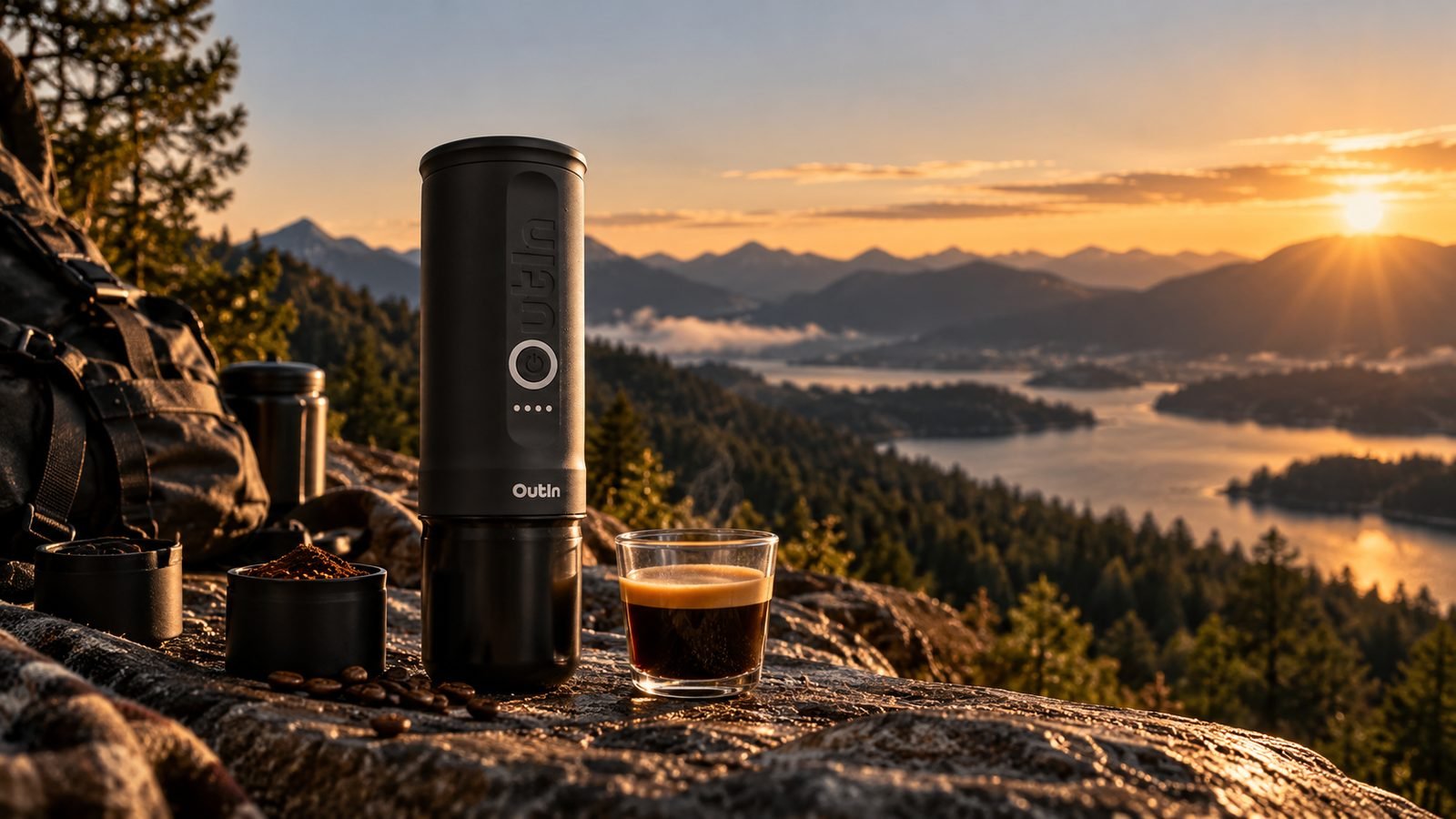
A self-heating maker covers heat and pressure for you, so there is no stove to light. The OutIn Nano 2 heats water to about 93 °C and pumps at up to 21 bar, from ground coffee or Nespresso Original capsules.
How to do it
- Charge it before you leave. A full charge gives up to 9 shots from room-temperature water.
- Fill the basket with finely ground coffee, or put a Nespresso Original capsule in the adapter.
- Pour 50–85 ml of water into the tank. Cold or room-temperature water is fine.
- Press the button. It heats the water (about 160 s for 50 ml) and pulls the shot into the cup.
- Knock the puck into your trash bag and rinse the basket.
- Best for
- Least gear, least effort
- You need
- The maker, water, coffee
- True espresso
- Yes, up to 21 bar
- Needs a stove
- No
Why it works
- No fire, no kettle: works anywhere
- Same result every time, almost no technique
- Tip: start with hot water from a thermos and the battery lasts much longer
Keep in mind
- The heaviest option (740 g)
- Needs charging between trips
- Splash resistant, not waterproof
2. Method 2: A hand-pump espresso maker (No battery)
Our pick: Wacaco Nanopresso
Hand pumps make true espresso with your own force and weigh around 350 g, so they suit ultralight trips where you already carry a stove. The Wacaco Nanopresso is the forgiving choice; the Wacaco Picopresso gives more control. Our Nano 2 vs Picopresso comparison covers the trade-offs.
How to do it
- Bring water to a boil and let it rest a few seconds.
- Preheat the maker by running some hot water through it.
- Dose finely ground coffee into the basket and level it.
- Fill the tank with hot water and assemble the maker.
- Pump steadily until the shot is pulled. Expect a few practice shots before it tastes right.
- Best for
- Ultralight trips with a stove
- You need
- Maker, stove and pot, ground coffee
- True espresso
- Yes, up to 18 bar
- Needs a stove
- Yes
Why it works
- Light and compact (~340 g for the Nanopresso)
- No battery to run flat
- Forgiving with pre-ground coffee
Keep in mind
- Needs near-boiling water for every shot
- Hand pumping takes some effort
- One ~8 g shot at a time as standard
3. Method 3: A moka pot on a camp stove (For groups)
Our pick: Bialetti Moka Express
The classic Italian stovetop pot brews several servings at once and has no parts to break. It brews at roughly 1–2 bar, far below espresso pressure, so you get strong, rich “stovetop espresso” rather than true espresso with crema. The Bialetti Moka Express is the original design and comes in several sizes.
How to do it
- Fill the bottom chamber with water up to the valve.
- Fill the basket with medium-fine coffee and level it without pressing.
- Screw the pot together and set it on low to medium heat.
- Take it off the heat as soon as it starts to gurgle.
- Best for
- Strong coffee for several people
- You need
- Moka pot, stove, ground coffee
- True espresso
- No: about 1–2 bar
- Needs a stove
- Yes
Why it works
- Makes several servings at once
- Simple, durable, nothing to charge
- Easy to learn
Keep in mind
- No real crema
- Can taste bitter if left on the heat too long
- Bulkier to pack than a hand pump
4. Method 4: An AeroPress (Lightest kit)
Our pick: AeroPress Go
The AeroPress makes an espresso-style concentrate by steeping and pressing, not true espresso. It is very forgiving, nearly unbreakable and easy to clean, and the Go version packs into its own 15 oz mug.
How to do it
- Add a filter and finely ground coffee to the chamber.
- Pour in a small amount of hot water, stir, and steep for about a minute.
- Press slowly and steadily into your cup.
- Drink it as a concentrate or top it up with hot water for an Americano.
- Best for
- Light, simple kit and full cups
- You need
- AeroPress, filters, hot water, coffee
- True espresso
- No: concentrate
- Needs a stove
- Yes
Why it works
- Very forgiving, very easy to clean
- Packs into its own mug (~326 g total)
- Brews full cups, not just shots
Keep in mind
- No espresso pressure or crema
- Uses paper filters (or an aftermarket metal one)
Tips for better coffee at camp
- Keep coffee airtight. Pre-ground coffee goes stale fast; pack it in a small airtight container, away from heat.
- Preheat your cup. A splash of hot water keeps a small shot hot longer, especially on cold mornings.
- Use clean water. Coffee is mostly water, so filtered water tastes noticeably better.
- Pack out your grounds. Used coffee does not belong on the trail or in a fire ring: bag it and carry it out.
- Keep electronics dry. Battery-powered makers are usually splash resistant, not waterproof.
FAQ
Can you make espresso without electricity?
Yes. A hand-pump espresso maker like the Wacaco Nanopresso uses your own force to create espresso pressure. You only need hot water from a stove or kettle.
Is moka pot coffee real espresso?
Not quite. A moka pot brews at about 1–2 bar, while espresso is usually brewed around 9 bar. The result is strong and rich but has no real crema.
What is the easiest way to make espresso while camping?
A self-heating, battery-powered maker. With the OutIn Nano 2 you add water and coffee and press one button: no stove, no pumping.
How do I keep coffee fresh on a trip?
Buy whole beans close to your trip, grind just before you leave (or bring a hand grinder), and store the coffee in a small airtight container out of the sun.
OutIn Nano 2: Self-heating, battery-powered, and small enough for a jacket pocket. Check price on Amazon